“Awesome course and trainers!”
Certified Data Annotator
Image Segmentation ESSENTIALS
Go deeper into pixel-level work: polygon, polyline and mask annotation for satellite imagery and retail AI.
5 Days Intensive
DeeLab Academy certificate
Counts towards Certified Data Annotator certification: 6 courses required.
Course Fee
Access to your course in the DeeLab Learning Portal
Live sessions with industry trainers
Hands-on datasets and annotation tools
DeeLab Academy certificate included
Overview
Become a certified Image Segmentation professional.

Segmentation is labelling at the pixel: not a box around the car but its exact outline, not roughly where the road is but precisely which pixels are road.
It is the work behind medical imaging, autonomous driving and any system that needs to know shapes rather than positions, and it pays for patience and precision above everything else.
This course is five days with a live trainer. Day one grounds you in semantic segmentation and its foundational concepts; day two covers polyline annotation in the tools; day three is hands-on polygon segmentation with trainer support; day four is trainer-led mask-based annotation. You work in Label Studio or CVAT on real imagery, building the edge discipline that separates usable masks from rejected ones. Day five is a practical competency evaluation with your trainer, and passing it earns the certificate.
One of the six courses of the Certified Data Annotator programme: each one you pass counts toward the credential, and completing all six earns it. Available on its own or as part of the programme, with the certificate included on passing the assessment.
What You Get
What's included in your training
Trainee Portal & Labeling Tools
This course in the DeeLab Academy portal with its materials, scripts and datasets, plus hands-on work on real annotation platforms (Label Studio, CVAT) running on our servers.
Live Sessions & Trainer Support
Daily live workshops on Google Meet with Q&A, plus trainer support between sessions via chat on the Trainee Platform. Session times are set around each cohort.
Session Recordings
Recordings of every session, for anyone who can't attend live.
DeeLab Academy certificate
Certificate issued within one week after you pass the assessment and confirm the publicity details for your certificate.
Outline
What you'll learn
| Day | Session | Topics |
|---|---|---|
| Day 1 | Kick-off & Session 1 | Theory introduction to semantic segmentation: foundational concepts |
| Day 2 | Session 2 | Trainer-led tool navigation with practice: polyline annotation |
| Day 3 | Session 3 | Hands-on labeling with trainer support: polygon segmentation |
| Day 4 | Session 4 | Trainer-led practice: mask-based annotation techniques |
| Day 5 | Assessment with Trainer | Practical competency evaluation — required for certification |
Counts toward the Certified Data Annotator (CDA) certification programme.
Track Record
Previous Runs
| Dates | Status |
|---|---|
| 31 Aug 2026 – 05 Sep 2026 | Completed |
| 22 Jun 2026 – 27 Jun 2026 | Completed |
| 11 May 2026 – 16 May 2026 | Completed |
Success Stories
What our trainees say
Unedited feedback from graduates who completed this course.
“If you are interested in learning about data annotation, this is the company for you. They offer thorough, reasonably priced training and outstanding support.”
“Benard and Hannah’s efforts to make this course easy to grasp and practice are very much appreciated. They were very patient and professional while guiding us throughout, which made the course both beneficial and enjoyable. Thank you.”
“Nice course, knowledgeable team.”
“Happy with teaching module and resources provided for learning. Keep the good work going!”
“Nice experience so far!”
Two ways in
This course, or the whole programme
Just this course
Image Segmentation Essentials
One course, with its certificate when you pass.
Start any time,
at your own pace
Enrol
at your own pace
Best value
The full Certified Data Annotator
All 6 courses, and the programme certificate at the end.
19%
cheaper than buying
the courses one at a time
See the programme
the courses one at a time
Got Questions?
Frequently Asked Questions
Everything you need to know about this course.
The course is open to anyone — no prior AI knowledge or coding experience required. It works well for project managers and QA leads overseeing teams that do pixel-level work, contractors and freelancers who annotate segmentation data professionally, and developers or researchers building computer-vision products where scene understanding (not just object detection) is the goal. Understanding segmentation from the inside helps you plan better, communicate across teams, and produce higher-quality results faster.
All tools used in the course are free or very low cost — you can keep using them after the course ends. You will work with Label Studio (Community Edition) or CVAT (Community Edition) for polygon, polyline, and pixel-level mask annotation, and Google Drive for dataset organisation. A standard laptop with a modern browser is all you need.
You will be able to produce polygon, polyline, and pixel-level mask annotations to production standards on real image datasets, follow a clear label taxonomy and edge-case guidelines so your output is usable downstream, and meet the precision and consistency expectations production teams set for segmentation work. These are the day-one skills used inside medical imaging, satellite analysis, autonomous driving, and any AI that needs to understand a scene rather than just spot it. Project scoping, QA leadership, and team-role rotation are reserved for the Advanced courses and bootcamps.
Yes — Image Segmentation Essentials is fully online and you can join from anywhere in the world. We are also open to designing on-site workshops for organisations with sufficient demand; reach out through our contact page if you would like an in-person format for your team.
There is currently no formal industry-wide certification body for data annotation training — a gap the AI ecosystem is still addressing. DeeLab Academy follows the best current industry practices and methodologies, our curriculum is designed and delivered by a five-member team of multi-year industry experts, and we collect structured feedback from every cohort to keep improving the content. We are fully open to being audited by any recognised consultancy that wishes to validate our processes.
You have three months to complete the course, counted from the day you sign up. That applies whether the course is self-paced or runs to a schedule. The deadline is fixed from your sign-up date and doesn't reset if you move to a later run.
Yes, you're automatically enrolled in the run you choose, and you can move to another scheduled run of the same course up to twice from your dashboard. Your payment carries over, and your completion deadline does not change because it runs from the day you signed up.
From the blog
Related articles
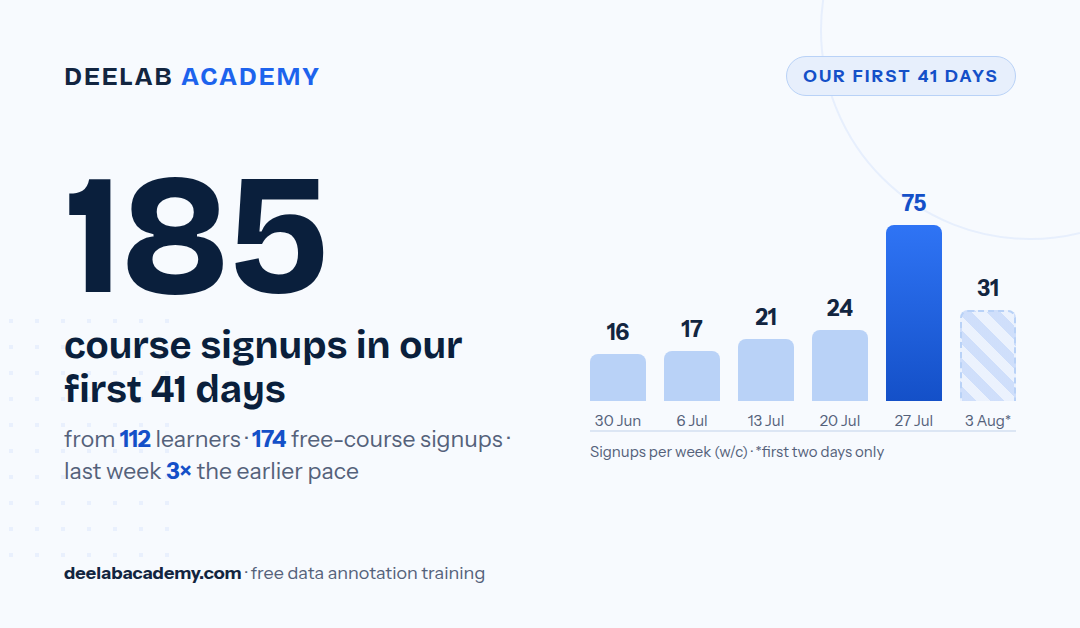
In its first 41 days, DeelabAcademy.com recorded 185 course signups from 112 learners, with weekly signups tripling in late July. Course ratings average 4.78/5 from 136 reviews. A summary of the first month: who signed up, what they took, and what they said.
5 min read · 05 Aug 2026
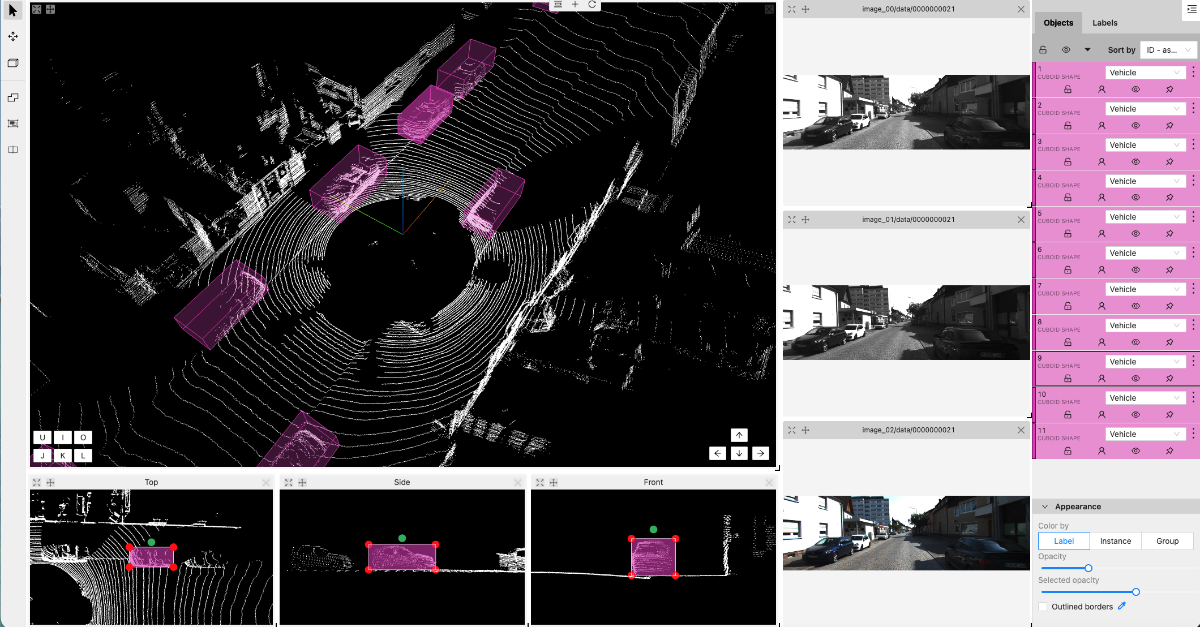
Point cloud labeling is one of the fastest-growing skills in data annotation — powering self-driving cars, robotics, and 3D mapping. This beginner's guide explains what point clouds are, how annotation works, the industries that rely on it, and the tools used to capture and label 3D data.
7 min read · 25 Jun 2026

Every chatbot reply, spam filter and translated sentence rests on text that a human once labelled. Text labeling marks entities, sentiment, intent and structure in raw language so a model can learn to work with it.
9 min read · 21 Jul 2026
More on these topics
Related Programmes