
Image Labeling
ESSENTIALS
Image labelling is where most computer vision starts. You will work through bounding boxes, polygons, semantic segmentation, and keypoints o...
View course
Annotation is where AI starts. Six weeks of doing that work on real datasets — image, video, audio, text, segmentation, and 3D point cloud — with a live cohort, supervised assessment, and a verifiable credential at the end.
Certification requires 6 courses — currently 6 available.
Taking individual courses? Complete any 6 courses from this programme to earn the CDA certificate. Requirements may be updated as the programme develops.
Programme Fee
S$788What You'll Learn
6 hands-on modules covering the full spectrum of professional data annotation. Each module earns its own certificate.
ESSENTIALS
Image labelling is where most computer vision starts. You will work through bounding boxes, polygons, semantic segmentation, and keypoints o...
View courseESSENTIALS
Video annotation is image labelling with memory — every frame is a decision and every track is a story. You will learn classification, frame...
View courseESSENTIALS
Train your ear the way models train. You will work through speech transcription, speaker diarization, and sound-event detection on real audi...
View courseESSENTIALS
Text annotation is what teaches a model to read. You will learn sentiment analysis, intent detection, topic classification, named-entity rec...
View courseESSENTIALS
A bounding box says something is here. Segmentation says this exact shape, down to the pixel. You will train your eye on polygons, polylines...
View courseESSENTIALS
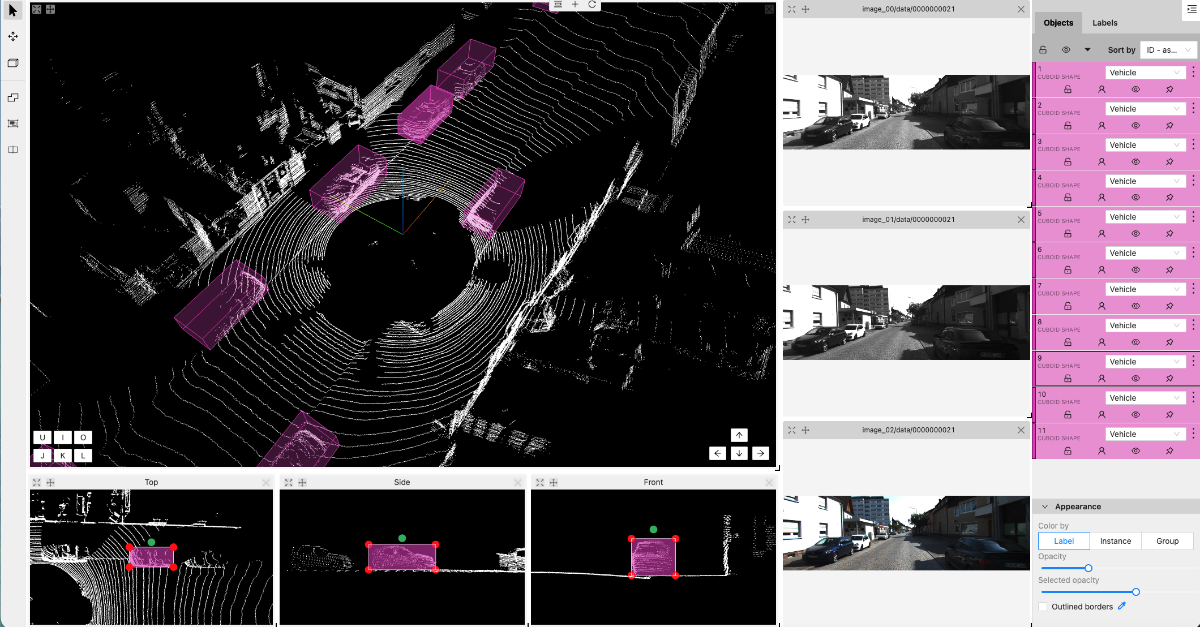
Add the third dimension. You will annotate raw 3D data captured by LiDAR, depth cameras, and photogrammetry rigs — placing 3D cuboids and se...
View courseIf a run doesn't fill
Each course run needs at least 3 trainees to go ahead. If one doesn't reach that in time, we move you to the next available run for that course at no charge and let you know the new date. Your place in the programme, and your path to the Certified Data Annotator certificate, stay exactly as they are.
Real feedback from professionals who completed this programme.
“Excellent training. Enjoyed learning from Ms. Hannah Ndulu”
“If you truly want to learn image annotation with a really patient and knowledgeable team of professionals then look no further than DeeLab.”
“The diversity of the materials covered made it both interesting and enriching, providing valuable theoretical and practical knowledge. I appreciate the continuous efforts exerted by Benard and Hannah, as well as their professionalism and patience, which made the course even more enjoyable. Thank you.”
“Overall it was an excellent experience. The trainer was really patient in explaining everything clearly. He made the sessions interactive and addressed all our queries properly. The hands-on practice sessions were also really helpful. The course coordinator was very supportive and well-organized throughout the training.”
“I really enjoyed DeeLab Academy, Please have other annotations classes in the future so I can keep up with the industry. Thanks!”
“I recently completed the data annotation training at DeeLab Academy, and it was an outstanding experience! The course provided hands-on practice that really boosted my skills. The instructor was knowledgeable and supportive, making complex concepts easy to understand. Highly recommend DeeLab Academy for anyone.”
Ready to get certified?
6 practical modules · S$788
Everything you need to know about this programme.
The programme is open to anyone — no prior AI knowledge or coding experience required. It works well for career changers moving into AI, professionals who already touch data quality (QA, content moderation, transcription, operations) and want a structured skill set, freelancers and contractors after a verifiable credential, and team leads who want a complete picture of the full pipeline. Six weeks of focused effort is what we ask — the rest we teach.
All tools used in the programme are free or very low cost — you can keep using them after the programme ends. You will work with Label Studio (Community Edition), CVAT, MakeSense.ai, and Roboflow depending on the week's data type, and Google Drive for dataset organisation. Specialist viewers for 3D point cloud or video work are open-source or browser-based. A standard laptop with a modern browser is all you need.
You will be able to produce production-quality annotations across image, video, audio, text, segmentation, and 3D point cloud datasets, follow consistent label taxonomies across each modality, and meet production-team speed and consistency expectations across the full pipeline rather than just one data type. This breadth is what differentiates CDA from a single Essentials course — graduates leave able to take on annotation work across multiple AI domains. Project scoping, QA leadership, and team-role rotation are reserved for the bootcamps.
Yes — the Certified Data Annotator programme is fully online and you can join from anywhere in the world. We are also open to designing on-site workshops for organisations with sufficient demand; reach out through our contact page if you would like an in-person format for your team.
There is currently no formal industry-wide certification body for data annotation training — a gap the AI ecosystem is still addressing. DeeLab Academy follows the best current industry practices and methodologies, our curriculum is designed and delivered by a five-member team of multi-year industry experts, and we collect structured feedback from every cohort to keep improving the content. We are fully open to being audited by any recognised consultancy that wishes to validate our processes.
You have one year to complete the programme, counted from the end date of your first course run in it. We send reminders before the deadline. After a year, DeeLab Academy may remove you from the programme as an active participant.
Each course must be completed within three months of the end date of its first run. You can move to another scheduled run of the same course up to twice; the deadline stays pinned to your first run's end date.
From the blog