
Text Labeling: Teaching AI to Read

Every chatbot reply, spam filter and translated sentence rests on text that a human once labelled. Text labeling marks entities, sentiment, intent and structure in raw language so a model can learn to work with it.
Unlike an image, where the subject is usually visible at a glance, text carries its meaning in structure, context, and implication, all of which have to be made explicit before a model can learn from it. This article explains what text labeling actually involves, the main techniques annotators use, where the work shows up in everyday technology, the particular challenges of labelling language rather than pixels, and how to train for it.
What Is Text Labeling?
Text labeling is the process of tagging or marking up raw text so a machine learning model can learn to recognise meaning, structure, and intent within it. An annotator might highlight a person's name and mark it as an entity, tag a sentence as positive or negative in tone, or assign a support ticket to a category before a model ever sees the data.
The reason this matters comes down to what language models are actually trained to do. A model exposed only to unlabelled text can learn statistical patterns in how words follow each other, but it has no ground truth for what those patterns mean until annotators supply it. Labelled text is what turns a stream of words into training data a model can be evaluated against: this sentence is angry, this phrase is a place name, this ticket belongs in billing. Without that layer, a model has no way to check whether its own interpretation was right.
Text labeling sits within the wider discipline of data annotation, alongside image, video, audio, and 3D point cloud labelling. What sets it apart is the object being labelled, a word's sense, a sentence's tone, a passage's intent, often has no fixed visual boundary. Judging where meaning starts and ends is a linguistic skill, not a spatial one.
The Main Types of Text Annotation
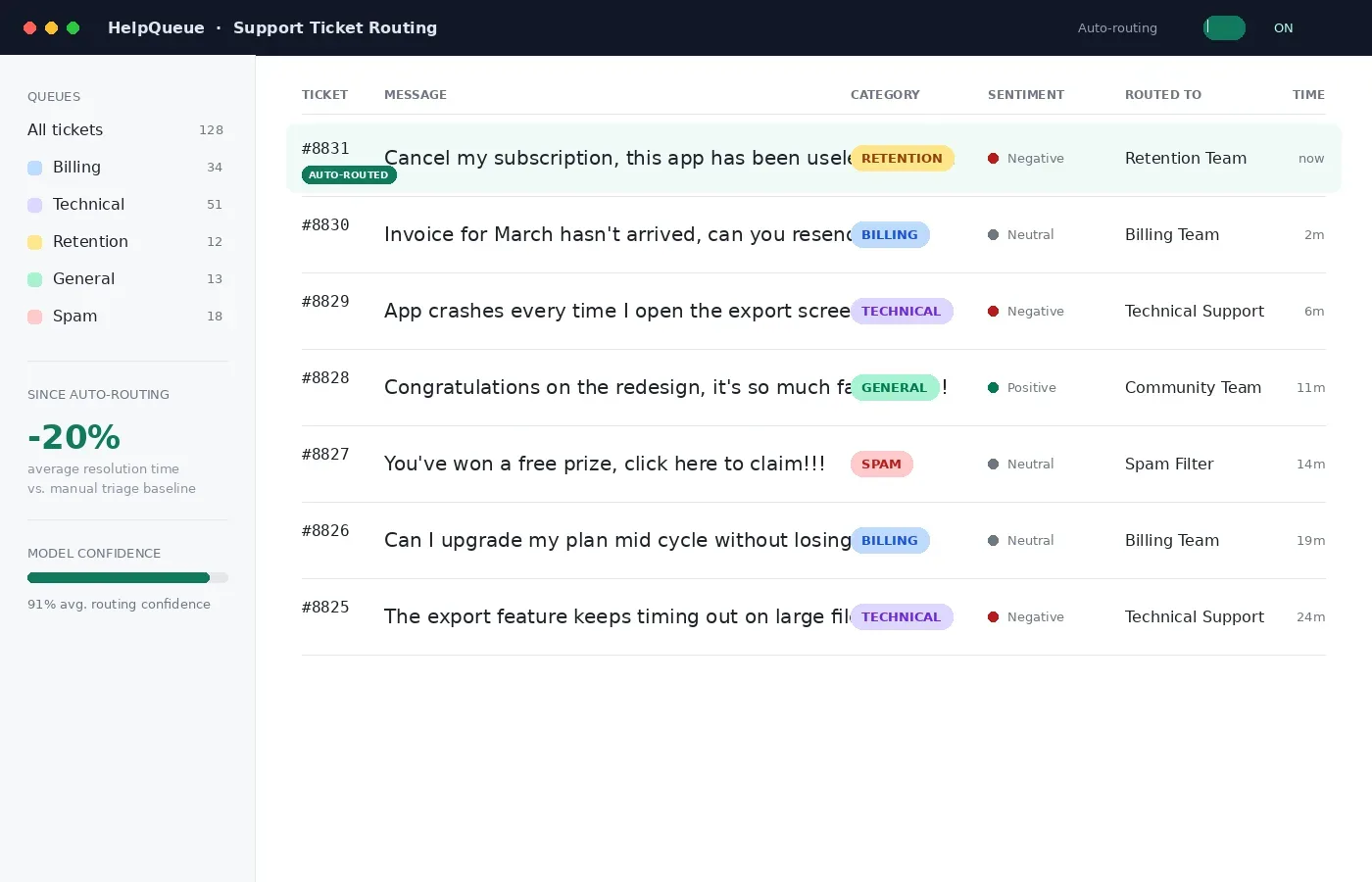
Take a real sentence a support team might see: "Cancel my subscription, this app has been useless since the update." A text annotation pipeline pulls that apart in a way that mirrors what an attentive person does instinctively. Sentiment labelling marks the tone as negative. Intent detection, a close relative of classification, tags the underlying request as a cancellation rather than a bug report, which is what actually decides whether the message lands with retention or with the support queue.
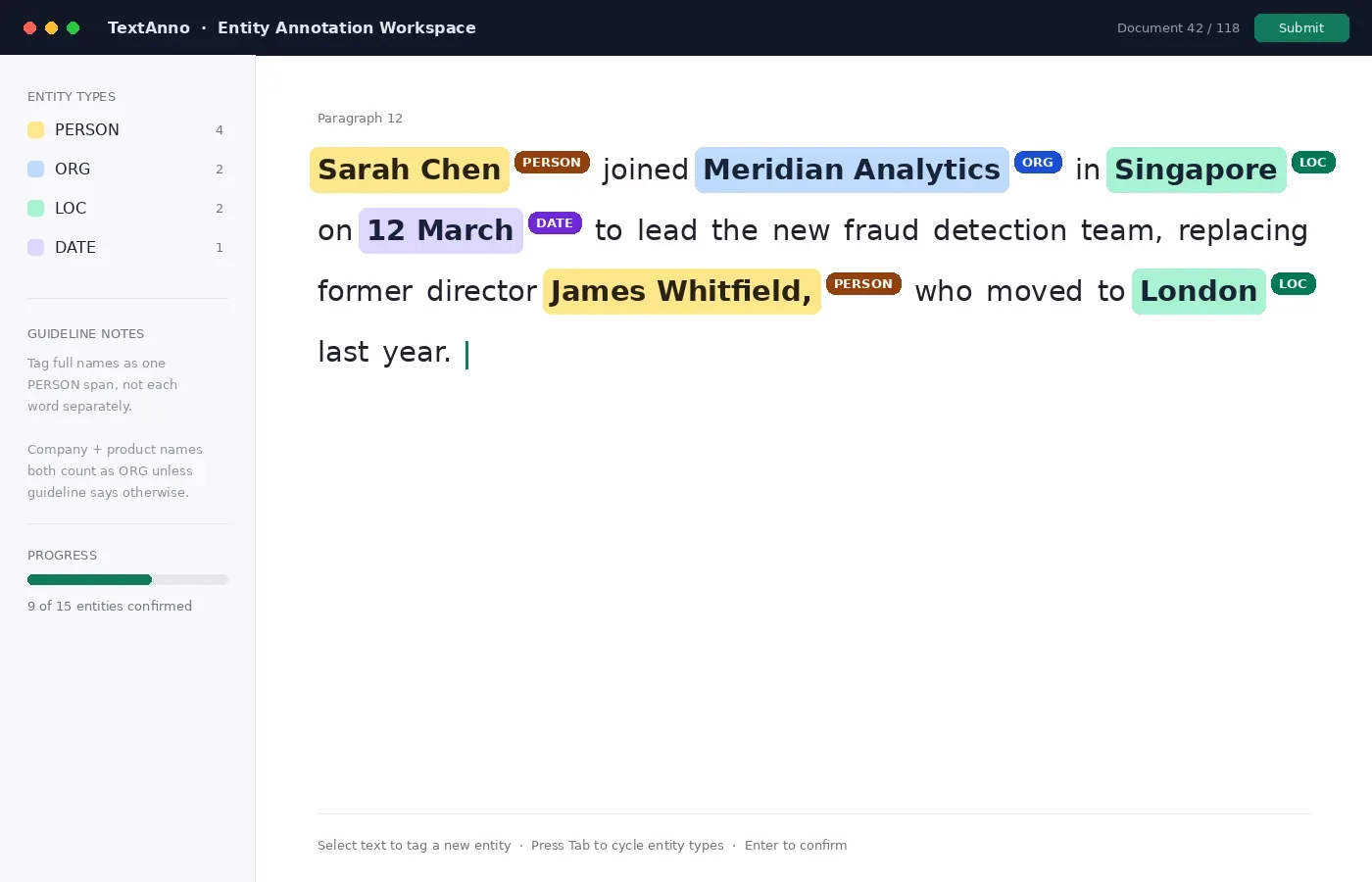
Named entity recognition handles a different job entirely: pulling names, places, dates, and organisations out of unstructured writing so a model can work with them as facts rather than just words. Recognising "Singapore" as a location or "3 August" as a date sounds close to trivial until the text gets messy, nicknames, abbreviations, and several entities crammed into one sentence all complicate what looks, on paper, like simple lookup work.
Classification operates at a coarser grain than entity recognition, assigning a whole document or passage to a category rather than marking specific spans within it: a support ticket filed under "billing," an email flagged as spam. It is as much a matter of taxonomy discipline as reading skill, since two annotators need to agree on exactly where one category ends and another begins before either can label consistently.
Underneath all of this sits quieter, more structural work. Part-of-speech tagging assigns each word a grammatical role, noun, verb, adjective, and syntactic parsing maps how those words relate to one another, groundwork that shows up in translation and grammar tools more than in anything a user directly sees. And once a document runs longer than a sentence or two, coreference resolution becomes necessary just to keep track of who is being discussed, linking "she" back to "the engineer" three sentences earlier so a model doesn't lose the thread the way a distracted reader might.
Most real projects layer several of these techniques onto the same document rather than choosing just one.
Where Text Labeling Is Used
Anywhere a system needs to read, understand, or generate human language, labelled text sits somewhere upstream of it. Chatbots and virtual assistants are the most visible case: a support bot deciding whether "cancel my subscription" needs escalating or can be resolved automatically is running the same intent detection and entity recognition described above, just applied to a live conversation instead of a training example. Search engines and recommendation systems use closely related techniques to match what someone is actually looking for rather than the literal words they typed, which is most of the difference between a search that works and one that returns near misses.
Some of the least visible applications are also the most consequential. Content moderation depends on text labelled for harassment, spam, and policy violations to draw a line between what should come down and what is merely unpleasant, a distinction that gets genuinely harder the closer a case sits to that line. Customer support automation runs on the same classification and sentiment labelling covered earlier, and the payoff is measurable: one e-commerce operator that automated ticket routing this way cut average resolution time by a fifth, simply by getting tickets to the right team on the first pass.
Machine translation depends on labelled text too, though less obviously. Annotated parallel text, along with syntactic and entity labels, is part of what lets a translation model preserve meaning and sentence structure across languages rather than substituting one word for another and hoping the grammar holds. In healthcare and legal work, meanwhile, entity recognition and classification pull medication names out of clinical notes or key clauses out of contracts, turning dense professional documents into something a system can actually search.
The Skills That Make a Great Text Annotator
Good text annotators read the way careful editors do, alert to how the same word can mean two entirely different things depending on what surrounds it. "Amazon" is a company in one sentence and a river in another, and no amount of individual talent replaces reading each passage in its own context rather than labelling words as though they existed in isolation.
That instinct for context has to be paired with discipline, because ambiguity left to individual judgment produces inconsistent datasets fast. Where does a sharp complaint tip into a genuine threat? Where does dry sarcasm read as sincere praise to someone skimming too quickly? Project guidelines exist to answer exactly these questions, and the annotators who do this work well are the ones who apply the same line on document one thousand as they did on document one, rather than letting judgment quietly drift as fatigue sets in.
 Related article
A Day in the Life of a Data Annotator
What does it actually look like to work as a data annotator? We follow a certified annotator through a full shift — the tools, the decisions, and the craft behi...
Read more →
Related article
A Day in the Life of a Data Annotator
What does it actually look like to work as a data annotator? We follow a certified annotator through a full shift — the tools, the decisions, and the craft behi...
Read more →
Figurative language adds a layer most people underestimate until they try to label it. Idioms, sarcasm, and cultural references rarely map onto literal labels, so annotators need enough linguistic feel to catch when a sentence means something other than what it appears to say on the surface. Long documents test a different muscle: legal contracts and clinical notes can run for pages, and a single missed entity or mislabelled clause near the end changes the value of the whole document just as much as an error on the first line would.
None of this requires a linguistics degree to start. It requires careful reading, a willingness to sit with ambiguity rather than resolve it too quickly, and enough discipline to apply a guideline the same way at hour eight of a shift as at hour one. Multilingual projects raise the bar further still, since meaning, idiom, and tone all shift between languages in ways a direct translation rarely captures on its own.
The Tools of the Trade
Text annotators typically work in platforms purpose-built for tagging spans, sentences, and documents, rather than adapting tools designed for images.
- Label Studio — a flexible open-source platform supporting entity tagging, classification, and sentiment labelling, useful for teams working across multiple annotation types.
- Doccano — an open-source tool built specifically for text annotation, popular for NER, classification, and sequence labelling tasks.
- Prodigy — a scriptable annotation tool often used for faster, active-learning-assisted labelling on NLP projects.
Most working annotators become comfortable in at least one open-source tool, since clients and projects vary in which platform they standardise on.
The Challenges Worth Knowing About
Language is genuinely ambiguous, and the same sentence can be read two valid ways by two careful annotators without either one being wrong. Clear guidelines and calibration exercises across a team are what keep labels consistent despite that, rather than any illusion that the ambiguity can be eliminated. That tension only gets harder under volume: large text datasets can run to hundreds of thousands of sentences or documents, and the pressure to move quickly works directly against the careful reading that nuanced labels actually require. Balancing throughput against accuracy is a constant part of the job, not a problem solved once and forgotten.
Language also refuses to hold still. New slang, new terminology, and shifting usage mean annotation guidelines themselves need revisiting periodically, since a label set built for one year's language can drift out of date faster than a visual category ever would. A slur that changes meaning, a piece of jargon that becomes mainstream, an emoji that starts carrying sarcasm it didn't a year earlier, all of it quietly erodes a guideline written before the shift happened.

Text also carries its own sensitivity considerations: annotators may encounter distressing, offensive, or private content in the course of moderation or classification work, and are trained to handle it according to project guidelines and with appropriate judgment.
Learn Text Labeling at DeeLab Academy
If this has you curious about the discipline, or about what to look for when hiring for it, DeeLab Academy trains and certifies annotators through hands-on, instructor-led courses.
Text Labeling Essentials is the direct route into the discipline:
- Format: live, instructor-led online sessions with hands-on labelling practice throughout
- Tools: practical work in Label Studio, covering entity tagging, classification, and sentiment labelling
- Techniques covered: named entity recognition, sentiment analysis, text classification, and intent detection, taught with a focus on consistency and guideline discipline
- Quality process: work submitted after each session with individual feedback, plus peer review
- Certification: a final practical assessment, with an official DeeLab certificate on passing
If you would rather explore the fundamentals first at no cost, Text Annotation Basics is one of the six free, self-paced courses in DeeLab Academy's Data Annotation Basics programme, and a good way to confirm the discipline is the right fit before committing to instructor-led training.
For those planning to work across data types rather than specialise in one, Text Labeling Essentials is also one of the six courses within the Certified Data Annotator programme.
 Related course
Text Labeling Essentials
Label and analyse text the way real NLP teams do, from sentiment analysis to NER for chatbots and LLM training.
Read more →
Related course
Text Labeling Essentials
Label and analyse text the way real NLP teams do, from sentiment analysis to NER for chatbots and LLM training.
Read more →
Free newsletter
Data annotation insights, straight to your inbox
Career guides, industry news, and practical tips — sent only when worth your time. No spam.
Kari is the founder of DeeLab and also the founder & CEO of Tailjay, a Singapore-based venture builder operating globally. At DeeLab, Kari leads a growing team of professionals focused on high-quality data annotation and project-based su...
Ready to level up?
Explore our data annotation courses
Put these insights into practice with hands-on training built for aspiring data annotators and AI teams.
Explore related topics
Related Programmes