Video Labeling: Teaching Machines to Understand Motion

Video labeling teaches AI to track objects, mark event boundaries, and recognise actions across a timeline. It underpins autonomous vehicles, sports analytics, security systems, and quality control on production lines.
A delivery robot rolls down a hallway and swerves before someone even steps into its path, because it has already noticed the shift in their stride. A sports analytics platform tags the exact second a striker changes direction. A factory camera flags a worker walking into a restricted zone, not because of what they look like, but because of the path they just walked. None of this comes from a machine recognising a single picture. It comes from a machine that has learned to watch something unfold over time.
That is the job of video labeling (also called video annotation): teaching AI not just what something is, but what it is doing, and how that changes from one moment to the next. It is one of the more demanding branches of data annotation, and one of the fastest-growing, because so much of the world's most useful visual data was never a photograph in the first place. This article covers what video labeling actually involves, where it shows up in everyday technology, the specific challenges that separate it from image annotation, and how to train for it.
What Is Video Labeling?
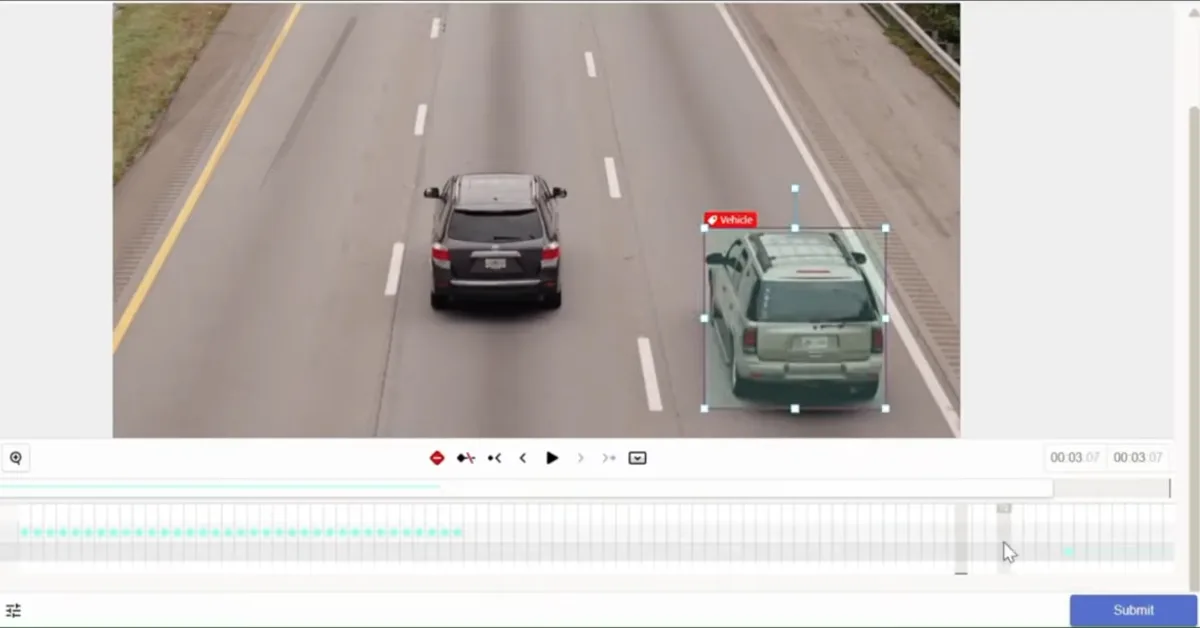
Video labeling is the process of annotating video footage, frame by frame or across sequences of frames, so a machine learning model can learn to recognise objects, actions, and events as they change over time. An annotator might draw a box around a car and keep that same box tracking the car as it moves through the scene, mark the start and end of a specific action, or label an entire sequence with what is happening in it.
The reason this differs meaningfully from labelling a single image comes down to what the model is being asked to learn. A model trained only on still images learns to recognise appearance: this is a car, this is a person, this is a dog. A model trained on labelled video learns something harder: how that car changes lanes, how that person's gait shifts before a fall, how a crowd's movement pattern changes in the seconds before a stampede. That extra dimension, time, is what makes video such a rich but demanding source of training data.
Video labeling sits within the wider discipline of data annotation, alongside image, text, audio, and 3D point cloud labeling. What sets it apart is the requirement to track identity and behaviour continuously across many frames, not just describe a single moment.
The Main Types of Video Annotation
Several annotation techniques are unique to, or especially important for, video work. Most real projects combine several of them across the same footage.
Object tracking. A bounding box, polygon, or keypoint set is placed on an object and then followed as it moves across frames, keeping a consistent identity attached to it throughout. This is what lets a model understand that the car in frame 40 and the car in frame 400 are the same vehicle, not two separate detections.
Temporal (event) annotation. Rather than marking where something is in a frame, temporal annotation marks when something happens, tagging the start and end timestamps of an action or event within a clip. A goal being scored, a door opening, a vehicle running a red light: each becomes a labelled segment on the timeline rather than a box on a single image.
Activity and action recognition. Related to temporal annotation, this labels what a person or object is doing across a sequence: walking, running, falling, reaching, loitering. It requires the annotator to judge the boundaries of an action, which are rarely as clean as a single frame.
Frame-by-frame segmentation. For the most demanding projects, every pixel in every frame is labelled, extending semantic segmentation from a single image into continuous motion. This is used where boundary precision matters throughout an entire sequence, not just at one point in time.
Interpolation-assisted annotation. Because manually annotating every single frame of a long clip is rarely practical, most professional tools let an annotator label key frames and use interpolation to estimate the object's position in the frames between them, with the annotator reviewing and correcting the result. Judging when interpolation is trustworthy and when it needs manual correction is itself a skill.
In practice, a single project might use tracking for vehicles, temporal annotation for traffic violations, and action recognition for pedestrian behaviour, all layered onto the same footage.
Where Video Labeling Is Used
Anywhere a machine needs to understand a changing scene rather than a fixed one, video labeling is likely behind it.
Autonomous vehicles and robotics. Self-driving systems and mobile robots rely on labelled video to learn how other vehicles, cyclists, and pedestrians behave over time, not just what they look like in a single frame. Predicting what happens next is the entire point.
Sports analytics. Player tracking, tactical analysis, and automated highlight generation depend on video labeling that follows individual players, the ball, and key events across a match, turning raw footage into structured, queryable data.
Security and surveillance. Systems that flag unusual behaviour, count people entering a space, or detect a restricted-area breach are trained on video labelled for exactly those events, so the model learns the difference between routine movement and something worth flagging.
Retail and manufacturing. Video labeling supports automated checkout systems that follow a shopper's actions, and quality-control systems that watch a production line for the moment a defect appears, rather than inspecting isolated stills.
Media and content platforms. Recommendation systems and content moderation tools rely on models trained to understand what is happening across a clip, not just its thumbnail, in order to categorise, tag, and route video content accurately.
Healthcare and research. Labelled video of gait, movement disorders, or surgical procedures helps train models used in diagnosis support and clinical research, where the pattern of movement over time is often the clinically meaningful signal.
The Skills That Make a Great Video Annotator
Video labeling asks for everything image annotation does, and then adds a few demands of its own.
Consistency across time. A box or label has to stay accurate and identity-consistent across hundreds or thousands of frames. A single dropped or mislabelled frame can break an object's tracked identity for the whole clip, so annotators need the discipline to check continuity, not just individual frames.
Judgment on occlusion. Objects in video are constantly disappearing behind other objects, re-emerging, and changing appearance as they move. Deciding whether a reappearing object is the same one that was tracked before, or a new one, is a judgment call annotators make constantly.
A feel for where actions begin and end. Marking the start and end of an event sounds simple until you try it: does a fall begin at the stumble or the impact? Good annotators learn to apply project guidelines consistently to these boundaries rather than guessing frame by frame.
Patience with repetitive, detail-heavy work. Video projects can involve long sequences and many frames per clip. Maintaining the same standard of care in frame 900 as in frame 9 is what separates reliable annotators from the rest.
Comfort with specialised tools. Video annotation platforms have their own interfaces for tracking, interpolation, and timeline-based labelling, distinct from the tools used for static images. Learning to use them efficiently is part of the craft.
As with other forms of annotation, none of this requires a technical background to start. It requires attentiveness, consistency, and a willingness to learn the tools and the guidelines properly.
 Related article
What Makes a Great Data Annotator? The Skills, Tools and Mindset Behind Certified Quality
Technical skills matter, but the best annotators bring something more — a rigorous mindset, a questioning approach, and genuine respect for the craft of precise...
Read more →
Related article
What Makes a Great Data Annotator? The Skills, Tools and Mindset Behind Certified Quality
Technical skills matter, but the best annotators bring something more — a rigorous mindset, a questioning approach, and genuine respect for the craft of precise...
Read more →
The Tools of the Trade
Video annotators typically work in platforms built specifically to handle timelines, tracking, and interpolation, rather than single-frame tools.
- CVAT — the open-source Computer Vision Annotation Tool, widely used for both video and image work, with built-in support for object tracking and interpolation between key frames.
- Label Studio — a flexible open-source platform that supports video timeline annotation alongside other data types, useful when a team works across multiple annotation formats.
- Labelbox and other commercial platforms also offer video-specific tooling, particularly for larger, team-based projects with review workflows built in.
Most working annotators become comfortable moving between at least one open-source and one commercial tool, since different projects and clients standardise on different platforms.
The Challenges Worth Knowing About
Two tensions run through almost every video annotation project.
Volume versus attention. A single minute of video at a typical frame rate can contain well over a thousand frames. Labelling every one by hand is rarely feasible, which is why interpolation and tracking assistance exist, but leaning on them too heavily without careful review introduces drift and error. Knowing when to trust the tool and when to intervene manually is a skill that develops with practice.
Consistency across a whole dataset. Lighting changes, camera motion, and occlusion all affect a scene differently from one clip to the next. Keeping labelling standards identical across a large, varied dataset, and across multiple annotators working on it, is what makes the resulting data usable rather than noisy.
Video also raises the same sensitivity considerations as other visual data: footage can include people, private settings, or culturally sensitive content, and annotators are trained to handle it according to project guidelines and with appropriate judgment.
Learn Video Labeling at DeeLab Academy
If this has you curious about the craft, or about what to look for when hiring for it, DeeLab Academy trains and certifies annotators through hands-on, instructor-led courses.
Video Labeling Essentials is the direct route into the discipline:
- Format: live, instructor-led online sessions with hands-on labelling practice throughout
- Tools: practical work in Label Studio, covering object tracking, interpolation, and timeline-based annotation
- Techniques covered: bounding-box tracking, temporal event annotation, and action labelling, taught with a focus on consistency across frames and accurate event boundaries
- Quality process: work submitted after each session with individual feedback, plus peer review
- Certification: a final practical assessment, with an official DeeLab certificate on passing
If you would rather explore the fundamentals first at no cost, Video Annotation Basics is one of the six free, self-paced courses in DeeLab Academy's Data Annotation Basics programme, and a good way to confirm the discipline is the right fit before committing to instructor-led training.
For those planning to work across data types rather than specialise in one, Video Labeling Essentials is also one of the six courses within the Certified Data Annotator programme.
Want DeeLab to handle annotation for your project instead? Explore DeeLab Video Labeling services. Want to learn the craft yourself? Start with Image Labeling Essentials at DeeLab Academy.

Free newsletter
Data annotation insights, straight to your inbox
Career guides, industry news, and practical tips — sent only when worth your time. No spam.
Kari is the founder of DeeLab and also the founder & CEO of Tailjay, a Singapore-based venture builder operating globally. At DeeLab, Kari leads a growing team of professionals focused on high-quality data annotation and project-based su...
Ready to level up?
Explore our data annotation courses
Put these insights into practice with hands-on training built for aspiring data annotators and AI teams.
Explore related topics
Related Programmes