“Great course for beginners!”
Data Annotation Basics
Image Annotation BASICS
Draw your first bounding box and label what you see. How ordinary photos become training data for computer vision.
Self-Paced
Always Open
Optional Certificate
Part of the Data Annotation Basics programme.
Self-Paced · Always Open
Free
Optional certificate:
Learn at your own pace, with no fixed schedule
Structured self-paced course modules
Theory lessons, examples, and knowledge checks
Optional paid certificate (after passing the assessment)
Overview
Start your Image Annotation journey.
If you’ve never annotated data before, image labeling is where almost everyone starts.
The work is visual and direct: you look at an image, decide what’s in it, and apply a structured label — a class name, a bounding box around an object, a tag, an attribute like colour or condition. Models trained on this work power everything from product search to medical screening to self-driving perception.
This Basics course covers the conventions: image classification, object detection with bounding boxes, multi-label tagging, attribute annotation, and how to tell a correct annotation from a bad one. Self-paced theory and knowledge checks; no fixed schedule.
Part of the Data Annotation Basics learning track. Optional verifiable certificate available for a small fee.
What You Get
What's included in your training
Structured Learning Modules
Learn at your own pace through structured modules on the DeeLab Academy learning platform.
Self-Paced Schedule
No fixed schedule. Start when you want, finish at your own pace.
Knowledge Checks
Worked examples and per-unit practice quizzes with instant feedback, plus a final knowledge assessment on the e-learning platform (80% to pass).
Optional Certificate
Optional verifiable certificate available for a small fee after you pass the final assessment.
Outline
What you'll learn
-
Image Classification
How image classification assigns a single class label to an entire image.
-
Object Detection / Bounding Boxes
What bounding-box object detection is and how rectangles label objects.
-
Image Tagging / Multi-Label
How multi-label tagging applies multiple non-exclusive labels to an image.
-
Attribute Annotation
What attribute annotation captures beyond identity: colour, size, occlusion, condition.
-
Spotting Correct vs Incorrect Image Annotations
How to recognise the difference between a clean annotation and a sloppy one.
Part of the Data Annotation Basics (DAB) programme.
Success Stories
What our trainees say
Unedited feedback from graduates who completed this course.
“Very useful! Covered all basics.”
“It was a great introduction to the topic! Clear and easy to understand.”
“I learned basics of image annotation in a very interesting and easy way.”
“I appreciate the time and effort put into creating this course. Thank you!”
“A very interesting course! It provides a basic understanding of image labeling. I liked it very much. I particularly liked the multi‑label markup and the attribute annotation.”
Got Questions?
Frequently Asked Questions
Everything you need to know about this course.
It's designed for absolute beginners. No prior AI knowledge, no coding, no annotation background required. If you've never labelled data before, this is the natural place to start. It also works as orientation for project managers, QA leads, and anyone who works alongside annotation teams and wants to understand what the work actually involves.
Image labelling typically means drawing a rectangle (a bounding box) around an object and assigning a class. Image segmentation means drawing the exact pixel-level outline. Labelling is faster, more universal, and where almost everyone starts. Segmentation is slower, more precise, and the foundation for medical and autonomous-driving work. If you're new, start here; the Image Segmentation Basics course is the natural next step.
Self-paced theory lessons and an online knowledge assessment on the e-learning platform. The Basics tier is focused on understanding the conventions: what bounding boxes, classification, multi-label tagging, and attribute annotation are for, and how to recognise a clean annotation from a sloppy one. There is no hands-on work with annotation tools in this course; that comes in the paid Image Labeling Essentials course.
The course is free, but the certificate is not — claiming it is optional and costs a small fee. It's a verifiable confirmation that you've completed the self-paced course and passed the online knowledge assessment. Useful as proof of foundation knowledge on a CV or LinkedIn profile. It is honest about its scope: it does not mean you've been trained to production-annotator standards. That's what the paid Image Labeling Essentials course is for. Essentials-level courses make up the Certified Data Annotator (CDA) programme.
Three paths from here. To broaden your foundation, the Data Annotation Basics (DAB) programme has free courses on video, audio, text, segmentation, and 3D point cloud, all at the same level as this one. To go deeper into image labeling specifically, the paid Image Labeling Essentials course is the next level up: online sessions with an industry trainer, access to the labeling tools used in production, ongoing support, and a graded final assessment. The Essentials-level courses make up the Certified Data Annotator (CDA) programme. Separately, we run the Object Detection Bootcamp (ORB): a 4-week cohort with intensive learning-by-doing on real data. ORB is its own track with its own bootcamp certification; the requirements match (and in places exceed) the equivalent CDA course, but the two tracks don't share credentials. Pick what fits how you learn best.
You have three months to complete the course, counted from the day you sign up. Within that window it is entirely self-paced and always open; your progress is saved automatically and you can return whenever suits you.
From the blog
Related articles
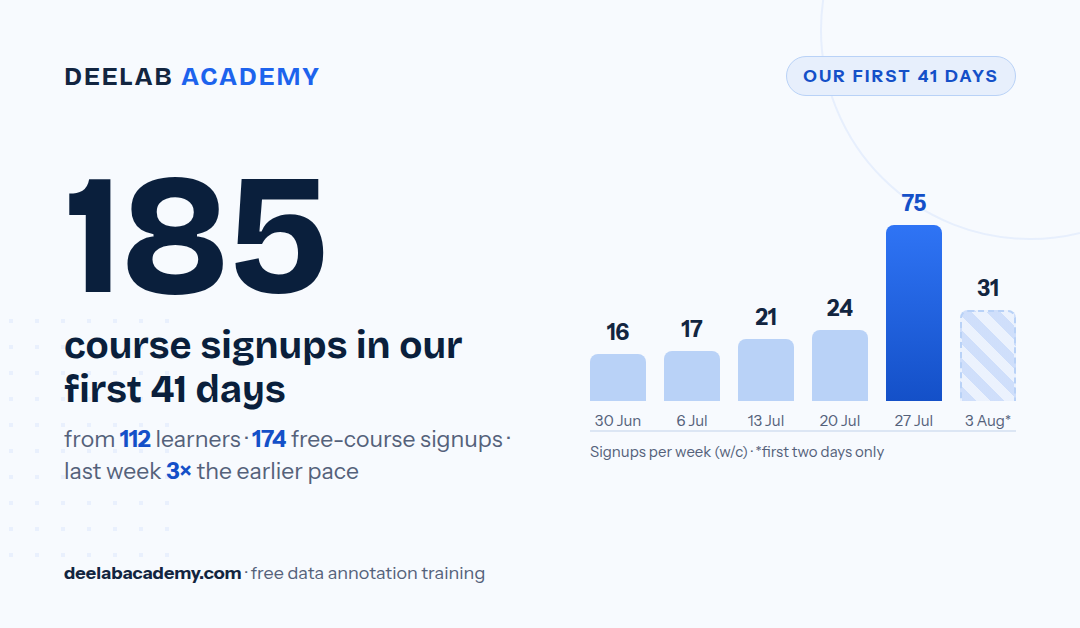
In its first 41 days, DeelabAcademy.com recorded 185 course signups from 112 learners, with weekly signups tripling in late July. Course ratings average 4.78/5 from 136 reviews. A summary of the first month: who signed up, what they took, and what they said.
5 min read · 05 Aug 2026
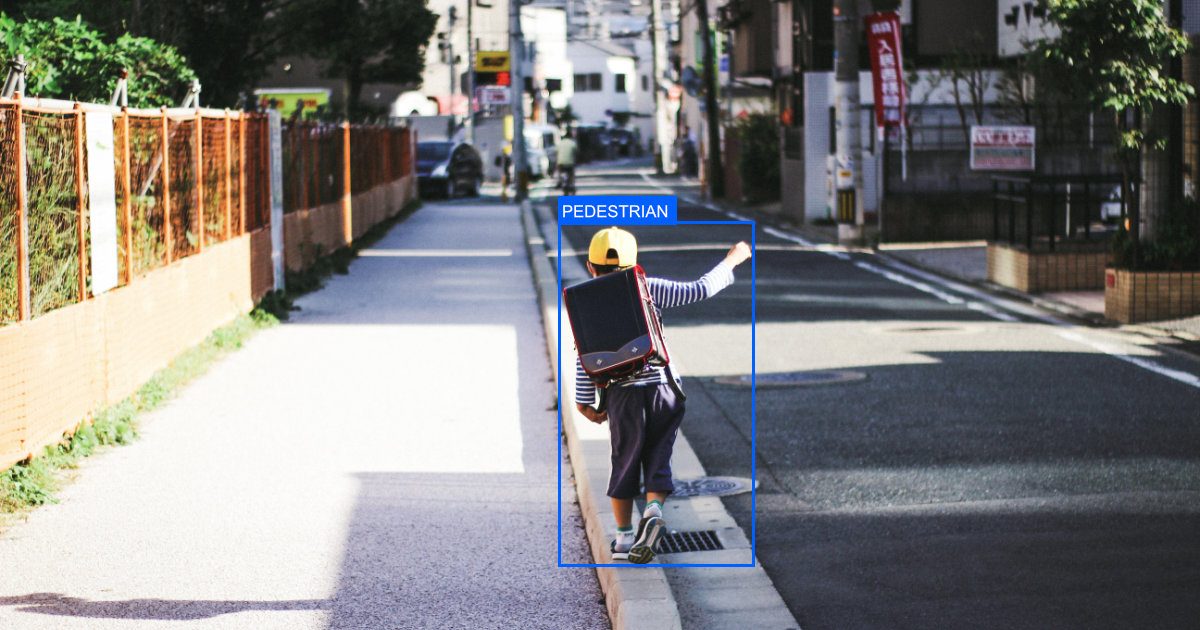
Image annotation turns ordinary pixels into training data machines can learn from. Here's what it is, where it's used, the skills and tools it takes — and how to get certified at DeeLab Academy.
10 min read · 23 Jun 2026

Data Annotation Basics is DeeLab Academy's new free programme: six self-paced courses, one for each main type of annotation. Each teaches the principles of its discipline and is the no cost way to learn the field and find which type suits you.
10 min read · 20 Jun 2026
More on these topics
Related Programmes